
The Chase - World Tour
Barnstorm GamesTrivia
4.651.00 Reviews
- Version
- 1.14.1
- Installs
- 10.00K
- Age Rating
- Everyone
Screenshots




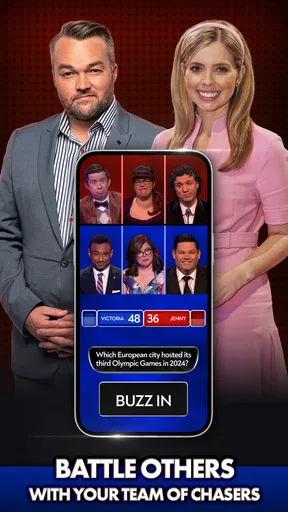



Our Review of The Chase - World Tour
 Analysis by Appyee
I approached The Chase - World Tour as a quick quiz game rather than a replacement for the television show, and that distinction matters. It is a free trivia game from Barnstorm Games built around the familiar question of whether you can stay ahead of the Chaser. The format is easy to understand, but the interesting part is how much your results depend on rhythm, risk management, and resisting the urge to answer before you have actually read the question.
After spending time with it, I think it works best in short sessions: a few rounds while waiting for an appointment, a relaxed challenge with someone nearby, or a compact test of general knowledge before bed. It is not a deep strategy game, and it does not try to be one. Its appeal comes from turning a recognizable quiz-show structure into something you can pick up immediately on a phone.
How the basic quiz routine feels in practice
The first useful habit is to treat each question as a small decision, not just a memory test. I read the full wording, identify exactly what is being asked, and only then look at the answer choices. That sounds obvious, but the pace of a quiz-show game encourages rushed guesses. In my experience, avoiding one careless answer is often more valuable than trying to appear fast.
The game’s trivia category gives it a broad feel. You may be comfortable with one subject and suddenly face a question from an area you rarely follow. That variety keeps a session from becoming predictable, although it also means that a poor run can sometimes reflect an unfamiliar topic rather than a lack of general knowledge. I found it more satisfying when I judged progress by the quality of my decisions instead of expecting every question to be within my strongest subjects.
The central tension comes from deciding how confidently to move forward. A safe choice can protect a good run, while a more ambitious choice may be tempting when you believe you know the answer. I recommend making that decision before tapping rather than changing your mind repeatedly. Second-guessing is especially unhelpful when two options look similar, because it turns a reasonable first impression into a nervous guess.
For a realistic everyday scenario, imagine playing during a short commute with only a few minutes available. I would not begin by trying to complete a long session or chase a perfect result. I would play one compact stretch, keep my attention on the wording, and stop when I noticed myself selecting answers automatically. The game is much better suited to that controlled rhythm than to distracted multitasking with several other apps open.
It is also a pleasant option for informal competition. Two people can compare how they approach uncertain questions, even when they do not have identical strengths. One player may know more about sport, another about entertainment or history, and the discussion after a surprising answer can be as enjoyable as the answer itself. Still, it should not be treated as a serious learning tool: answering questions can expose gaps in your knowledge, but the game’s main purpose is entertainment and challenge.
Settings and small choices worth checking
I would begin by looking through the available in-game settings before settling into regular play. The most important checks are practical: make sure the text is comfortable to read, confirm how sound behaves in your usual environment, and see whether notifications or other interruptions could break your concentration. I would not assume that a setting will improve performance; its value depends on whether it makes the screen and pace easier for you to manage.
Sound deserves particular attention. In a quiet room, audio can help create the show-like atmosphere, but it can become distracting in public or at night. I generally prefer a quieter setup when I am playing for concentration. If you enjoy the broadcast-style mood, sound may add character, but it should never be allowed to make you rush an answer.
Screen comfort is more important than it may seem. Trivia games often look simple, yet a question that is slightly difficult to read becomes a real disadvantage when time and attention are involved. I keep the phone at a steady distance, avoid playing with glare across the display, and use the device orientation that makes the answer choices easiest to scan. These are ordinary adjustments, but they reduce mistakes that have nothing to do with knowledge.
The game is rated Everyone, which makes it approachable for family use, but that does not mean every session will suit every age equally. Younger players may enjoy the quick questions, while adults may be more interested in the risk of the chase. I would play alongside a child rather than simply handing over the phone, because explaining why an answer is right turns a missed question into a useful conversation.
It is worth checking the purchase flow before anyone else uses the device. The game is free to start, while optional in-app purchases range from $0.99 to $99.99 per item. That is a wide span, so I would make sure the device’s purchase protections are appropriate, especially if children can access it. This is not a criticism of the quiz itself, but it is a sensible part of setting up any free game with optional spending.
Faster play without careless tapping
Experienced play is less about tapping quickly and more about reducing wasted thought. I use a three-step pattern: read the question, eliminate answers that clearly do not fit, then choose the strongest remaining option. If I cannot explain to myself why one answer is better, I avoid inventing confidence. This routine is faster than repeatedly scanning all choices after I have already identified the likely answer.
Another useful pattern is to separate knowledge from recognition. Sometimes an answer feels familiar because you have seen the word before, not because you know it is correct. I pause for a moment and ask whether the wording supports that choice. This is particularly helpful in trivia, where a plausible name or date can look convincing even when the question is pointing somewhere else.
I also recommend saving your attention for the question currently on screen. Thinking about a previous mistake while the next one appears creates a double loss: you do not change the earlier result, and you may miss the new question. When I make an error, I note the subject mentally and move on. That habit keeps one unlucky answer from controlling the rest of the run.
A practical way to improve is to identify your personal error type. If you usually miss questions because you answer too quickly, focus on reading every word. If you hesitate between two choices, practice eliminating the clearly wrong option first. If your weakness is a subject area, treat those misses as a map of what to revise outside the game. The app becomes more enjoyable when you use it to understand your habits rather than simply chasing a higher result.
Do not confuse speed with mastery. A quick correct answer feels rewarding, but a carefully chosen answer under pressure shows better control. The most reliable players I know use a repeatable routine even when they are confident. That consistency matters because the game can move between familiar and unfamiliar topics without warning.
Where the format reaches its limits
The Chase - World Tour is not the right choice if you want a large educational reference, detailed explanations, or a structured course in a particular subject. A dedicated learning app will usually be better for building knowledge step by step, while a traditional trivia database may offer more control over categories and difficulty. This game’s strength is the chase-style tension, not comprehensive instruction.
It may also disappoint players who need complete control over every question type. Broad trivia is inherently uneven: one session can feel perfectly balanced, and another can lean heavily toward subjects you know well or barely follow. I see that unpredictability as part of the entertainment, but someone looking for precise practice in geography, science, or a language should choose a more specialized alternative.
The free entry is convenient, though optional purchases deserve attention. Players who want a completely cost-free experience should review the purchase prompts carefully and use device-level safeguards where necessary. The presence of purchases does not prevent casual play, but it means the game is better suited to people who are comfortable managing optional spending rather than ignoring it altogether.
Another limitation is the potential for repetition in the overall routine. The quiz-show structure is immediately accessible, yet it can feel familiar sooner than a game with several different modes or a strong progression system. I would use it as one of several casual games, not as the only app on my phone. Short sessions preserve its energy; extended play can make the question-and-answer loop feel less fresh.
Device compatibility is reasonably broad for an older phone, since it requires Android 6.0 or later. The current version is 1.14.1, so I would still keep the app updated when possible and check that the phone’s operating system is supported before installing. These details matter most for someone using an older device or sharing a family phone, where compatibility can be less obvious than it is on a recent model.
Who will get the most from it
I would recommend it to fans of televised quiz formats, casual trivia players, and anyone who enjoys making decisions under light pressure. It is particularly good for people who want a game that can be understood in seconds and played without learning a complicated control system. The free starting point makes it easy to try, while the Everyone rating supports relaxed family sessions.
It is less suitable for players who dislike broad general-knowledge questions, want a story-driven game, or become frustrated when a run is shaped by a subject outside their experience. It is also not my first recommendation for someone who wants to study. In that situation, I would choose a learning-focused app and use this one only as a change of pace.
The public reception is encouraging: The Chase - World Tour holds a 4.6 average from around 165 ratings, with more than 50 written reviews and over 10 thousand installs. Those figures suggest a modest but positive audience rather than a huge social phenomenon. I would read that as a reason to try it on its own merits, not as proof that every player will enjoy the same level of challenge.
Barnstorm Games has kept the concept focused. That focus helps the game feel approachable, but it also explains why the experience may not satisfy people searching for a wide collection of unrelated mini-games. You are coming here for a recognizable chase quiz, and the closer that matches your expectations, the more likely you are to enjoy it.
My verdict after building a repeatable routine
My preferred way to play is simple: check the sound and display settings, begin with a short session, read every question completely, eliminate weak answers, and treat mistakes as information rather than a reason to panic. That approach makes the game feel more strategic without pretending it has systems that are not there. It also keeps the experience comfortable on a phone, where distractions and rushed taps can easily affect a result.
The strongest reason to install it is the immediate quiz-show tension. The weakest reason would be expecting deep progression, detailed teaching, or unlimited variety. Optional purchases mean I would supervise access on a shared device, and the broad trivia mix means I would not use it as a precise study aid. Those are manageable trade-offs when the goal is a quick, familiar challenge.
Overall, I think this is a good free trivia game for short, focused sessions and casual competition. It rewards composure more than frantic tapping, and its best moments come when you make a measured choice while the pressure builds. If that sounds like the kind of challenge you want from your phone, I would give it a try; if you need a structured learning experience or complete control over topics, another category of app will serve you better.
Verdict
Strengths of The Chase - World Tour
- Fast-paced trivia rounds are easy to pick up and play anywhere.
- Worldwide locations give the quiz a varied, travel-themed presentation.
- Multiple chasers add variety to the challenge and replay value.
- Short matches suit quick sessions during commutes or breaks.
- Familiar TV-show format makes the rules clear for new players.
Limitations of The Chase - World Tour
- Some questions may feel repetitive after extended play.
- Later difficulty spikes can be frustrating for casual quiz players.
- Progress may depend heavily on answering under time pressure.
- The interface can feel busy during intense question sequences.
- Players wanting deep statistics or detailed explanations may find it limited.
Similar Picks in This Category
View All
Millionaire 2026 Quiz & Trivia
Quiz & Trivia Games by Submarine Apps4.5

Brain Test 2: Tricky Stories
Unico Studio4.7

Trivia Crack: Brain Quiz Games
etermax4.4

QuizzLand. Quiz & Trivia game
Quiz & Trivia Games by Mno Go Apps4.8

Brain Test: Tricky Puzzles
Unico Studio4.7

Logo Quiz
bubble quiz games4.5
Frequently Asked Questions
What is The Chase – World Tour?
The Chase – World Tour is a trivia game inspired by the popular quiz show format. You answer general-knowledge questions, compete against Chasers, and progress through different locations around the world. The game focuses on quick decision-making, multiple-choice questions, and building a higher score while trying to stay ahead of the Chaser.
How does the gameplay work in The Chase – World Tour?
Each round challenges you to answer questions under time pressure. Depending on the mode, you may first build a cash total and then face a Chaser in a head-to-head or team-style challenge. Correct answers help you advance, while mistakes can reduce your progress. The questions cover subjects such as history, entertainment, science, sport, geography, and everyday knowledge.
Can I play The Chase – World Tour offline?
Offline availability may depend on the specific version and features being used. Basic gameplay can sometimes remain accessible without a continuous connection, but online services, advertisements, updates, leaderboards, purchases, and certain content may require internet access. It is best to launch the game while connected at least once and check which modes remain available when your device is offline.
Is The Chase – World Tour free to download and play?
The game may be free to download, but it can include advertisements, optional in-app purchases, or other premium features. These purchases may provide extra content, remove ads, or offer gameplay-related advantages, depending on the version available in your region. Before downloading, review the store listing and confirm the supported payment and age settings on your device.
Is The Chase – World Tour suitable for children and casual players?
The Chase – World Tour is generally suitable for players who enjoy quiz shows and general-knowledge challenges, although question difficulty can vary considerably. Younger players may find some topics difficult, and the game may include advertising or optional purchases. Parents should check the official age rating, privacy information, and device purchase controls before allowing children to play.
Play our best games!


